Zevira, a designer jewelry brand from Spain
Zevira is a Spanish brand of designer jewelry built around symbolism. Its core idea is that a piece is not merely an accessory but a carrier of meaning, a personal talisman, and a story the wearer keeps close every day. Because of this, the assortment is organized around themed collections, each with its own symbolism and its own audience.
The catalog has several strong lines. The tarot collection plays on the imagery of the major arcana and an esoteric aesthetic. The nazar and evil-eye protector line answers a steady demand for protective amulets, which runs deep in Spain and across Latin America. The men's line is restrained, leaning on metal texture and clean geometry. Gift pieces are gathered separately, where the presentation, the packaging, and the occasion matter as much as the object itself. You can read more about the design thinking and the way the pieces are made in the crafted section of the brand site.
The materials are typical of mid to high-tier author jewelry: 925 sterling silver as the base, gold plating and rhodium plating as finishes, natural and semi-precious stones, and colored enamel. That detail matters enormously to us as a retouching studio, because silver, a gold-plated surface, matte enamel, and a transparent stone all behave completely differently in front of the lens, and each of these materials demands its own approach during editing.
The brand sells through its own online store and through international marketplaces. That means the photographs have to satisfy two sets of requirements at once: the brand aesthetic on its own site, and the strict technical standards of the platforms. Reconciling both inside a single pipeline was exactly the task in front of us, and it is the heart of professional jewelry photo retouching.
Why jewelry retouching is its own discipline
Editing jewelry photos differs from any other product retouching so dramatically that it honestly deserves to be treated as a separate specialty. When you retouch clothing, cosmetics, or appliances, you work with relatively large, matte, predictable surfaces. Jewelry is built the other way around: it is a tiny object with mirror facets that simultaneously reflects everything around it, refracts light inside its stones, and shows every speck of dust at extreme magnification.
Three factors make jewelry product photography technically brutal. The first is scale. A piece a couple of centimeters across is shown large on a product card, and the viewer sees details the naked eye would never catch in real life. The second is reflections. Polished metal is essentially a mirror of complex shape, and it faithfully reflects softboxes, walls, the operator, and the tripod. The third is depth of field. In macro work at close distance, the zone of sharpness is a fraction of a millimeter, and without special techniques part of the piece will always sit out of focus.
The entire technical stack of silver and gold jewelry retouching grows out of these three problems: focus stacking against razor-thin depth of field, painstaking cleanup against visible defects, and reflection control against chaotic reflections. Below we break down each block in detail, using real work on the Zevira catalog as the example.
Focus stacking for product photography of jewelry
Focus stacking is a technique in which one final sharp image is assembled from many frames shot with different focus planes. For jewelry this is not an option but a requirement, and here is why.
In macro work at close range, depth of field at a wide or even a medium aperture comes down to mere fractions of a millimeter. If you simply focus on the center of a pendant, the front facet and the rear bail immediately dissolve into blur. You cannot just stop down to f/16 or f/22 without consequences: at those values diffraction kicks in, the shot loses overall sharpness, facets stop ringing crisp, and stones go soft. It is a trap: a wide aperture gives a thin slice of sharpness, a closed one kills detail through diffraction.
There is only one way out, and it is focus stacking for product photography. The piece is shot as a series of frames, usually 15 to 20, and for complex three-dimensional pieces with a chain or several tiers, more, sometimes several dozen. Each successive frame shifts the focus plane a microscopic step deeper: first the nearest facet snaps sharp, then the center, then the far bail, the clasp, the bottom edge. After the shoot the whole series is merged into a single frame in which only the sharp zone is taken from each individual shot.
What we did on the Zevira stacks
Merging stacks is not a one-click automation but manual work. Automatic blending almost always leaves artifacts on jewelry: halos around thin facets, breaks along chains, mush on the sharp edges of symbols and engravings. So after the initial stack assembly we go through the problem zones by hand, masking in the right areas from specific frames of the series.
Micro-shifts between frames of the series are a separate headache. Even on a rigid tripod, micro displacements are possible over the time it takes to shoot 15 to 20 frames: from vibration, from the shutter firing, from the macro rail moving. At this magnification a shift of a few microns is already visible and produces doubled facets when stacked. We align the frames on reference points before merging and watch the edges of the piece, where doubling shows up first.
The result of proper focus stacking is a piece where every facet is sharp from the nearest to the farthest, every stone reads clearly, and the relief of every engraving is visible. This is exactly what separates a professional jewelry product card from an amateur shot where half the piece sits out of focus.
Cleanup: removing dust, lint, and micro-defects
Once the stack is assembled, a stage begins that takes up nearly more time than any other: cleanup. At maximum magnification, polished metal reveals absolutely everything: dust and lint that settled during the shoot, micro-scratches from storage and from handling the samples, fingerprints on the mirror surface, traces of polishing paste in the recesses of engraving.
We clean facet by facet, working the piece section by section at extreme zoom. It is meticulous work: a single pendant can carry several hundred tiny spots that are imperceptible on their own but together create the impression of a dirty, careless object. On polished silver, dust is especially merciless because it leaves dark dots on a bright mirror field.
An important nuance specific to jewelry: you have to clean without killing the texture. It is easy to overdo it and rub out fine engraving, a facet bevel, or the characteristic texture of a matte surface along with the dust. So cleanup is done with precision, with pinpoint techniques, with constant control to make sure the relief of the piece itself does not suffer under the speck being removed. On polished mirror zones we remove defects with one set of tools, on matte and textured ones with another, so as not to leave visible smudges of over-smoothing.
Silver and gold jewelry retouching: working the metal
Metal is the heart of jewelry retouching. Whether a piece looks expensive or cheap depends precisely on how the surface of the gold, silver, rhodium, or gold-plated finish is handled. Here we lean on several key techniques.
Dodge and burn for volume
The dodge and burn technique (lightening and darkening) is the foundation of giving metal volume. A polished piece often comes out either flat or with dark pits and dirty transitions. By hand, with soft brushes on separate layers, we build the light and shadow structure: we emphasize the convexities, deepen the shadows in the relief, run smooth gradients across the rounded surfaces. After well-executed dodge and burn, a ring or pendant stops being a flat picture and gains the form the eye reads as a three-dimensional metal object.
Rebuilding highlights and gradients on the polish
Polished metal lives on a clean, extended highlight and a smooth gradient from light to shadow. In the source frames these highlights are often ragged, with dirty edges and parasitic reflections inside. We rebuild clean highlights: we lay down an even bright line along the facet, clear the junk reflections out of it, and tune the gradient so the transition reads as a quality mirror polish rather than a blown-out patch. This is one of the main moves that makes silver look like silver and gold plating look like gold.
Separating matte and mirror surfaces
Many Zevira pieces combine polished and matte zones on a single object, sometimes plus enamel. In a photo these surfaces tend to blend together, and then the entire design intent is lost. We work each texture separately: mirror zones get a clean contrasty highlight, matte zones a soft diffused light without highlights, and enamel its own saturation and depth. Once the surfaces are separated, the piece reads the way it was conceived at the bench, which matters especially for collections where the contrast of textures is part of the design.
Reflection control
Mirror metal reflects the whole environment. Even with a perfect shoot inside a light tent, parasitic reflections remain on the facets: dark lines from the edges of the softbox, colored reflections from nearby objects, the outline of the operator. We remove these reflections by hand, keeping only the reflections that work for the form and emphasize volume. Reflection control is what separates a clean studio card from a shot where half the room is reflected in the ring.
Ring and gemstone retouching
If metal is form, then a stone is the play of light, and it is edited by its own rules. The pieces include brilliants, cubic zirconia, and natural semi-precious stones, and each has its own job in the frame. This is where ring and gemstone retouching becomes a craft in itself.
The main thing in retouching brilliants and stones is to convey the play and sparkle without tipping into overexposure. The cut facets must scintillate, throwing off their characteristic flashes of light, but if you overcook the brightness, the stone turns into a white blown-out blob with no structure. We raise the sparkle of the facets carefully, preserving the pattern of the cut and the internal reflections, so the viewer sees a faceted stone rather than a white smear.
For colored and natural stones, color rendering is critical. The stone must keep its true hue and saturation, transparency for transparent stones, depth for opaque ones. We pull out the correct color without pushing saturation into unnatural acid tones, and preserve transparency so it is clear the stone passes light through itself rather than looking like dyed plastic. We gently support the internal highlights and refractions in transparent stones, because those are exactly what create the sense of a living stone.
Stones with inclusions and natural texture
A separate class of tasks is natural stones with inclusions, veining, and a natural pattern. Here you cannot act the way you would with a clean transparent cubic zirconia. In a natural stone its non-uniformity is not a defect but a mark of authenticity, and smoothing it away is forbidden, otherwise the piece starts to look like cheap glass. We distinguish a technical flaw (dust, a stuck fiber, a reflection on the stone's surface) from the natural structure of the mineral itself, and remove only the former. Internal clouds, thin thread-like inclusions, the pattern characteristic of a particular stone, we preserve, but bring to a tidy, readable state, so the buyer sees a living natural material rather than a murky patch.
For opaque and semi-opaque stones, working with depth matters. Turquoise, onyx, agate, and mother-of-pearl give not the sparkle of facets but a soft internal glow and shifting sheen. We support this depth with careful local correction of contrast and saturation, so the stone does not look flat and matte, but also does not turn into an unnaturally glossy blob. The line between living and plastic is very thin here, and it holds precisely on manual local work, not on blanket filters across the whole frame.
Frequency separation and working in layers
Technically, all of this rests on several base methods of professional retouching, adapted to jewelry specifics.
Frequency separation lets us split the texture and the tone of a surface onto separate layers. On the high frequency we work with fine detail, metal texture, and small defects, on the low frequency with the overall distribution of light and shadow and with color transitions. This makes it possible to clean a surface without destroying its texture, and conversely to even out tone without touching detail.
The actual retouching file for a single jewelry piece is frequently hundreds of layers: separate layers for dodge and burn, for cleanup, for highlights, for each group of reflections, for stones, for the chain, for the clasp. All of it is held together by masks and curves. Masks let us apply a correction only to the precise zone, curves let us control light and color exactly on a specific area.
The small elements deserve a special mention: chains, clasps, thin links, fittings. They occupy little space in the frame but demand a disproportionate amount of time. Every link of a chain is a small reflective object with its own light and shadow, and to make a chain look tidy and expensive rather than like tangled wire, it has to be worked almost link by link. The same goes for clasps and earring fittings.
Complex cases: enamel, rhodium, oxidation, paired pieces
Much of the Zevira catalog is not simple smooth rings but pieces with a complex combination of finishes and textures. Such items require their own techniques, and it is precisely on them that the difference between surface processing and professional retouching becomes visible.
Colored enamel
Enamel on jewelry behaves in two ways at once: on one hand it is saturated color, on the other glossy enamel has its own highlight, like glass. The main mistake when editing enamel is either to push saturation so far the color becomes toxic and loses its nobility, or to kill the highlight and make the enamel look like matte plastic. We treat enamel as a separate surface: we keep the color deep but believable, preserve the characteristic glassy highlight where it exists in the original, and carefully remove only the parasitic reflections. At the border between enamel and metal it is important not to blur the seam: a crisp line between the colored fill and the setting is part of a tidy, expensive look.
Rhodium and gold plating
A rhodium finish gives a cold, bright, almost icy shine, whereas uncoated silver is slightly warmer and softer, and gold plating moves toward warm yellow. In a photo these tones are easy to confuse or to flatten into one averaged metal, and then a rhodium-plated piece looks like ordinary silver and gold plating loses its warmth. We hold the character of each finish: rhodium gets a clean cold highlight and a neutral-white polish, gold plating a warm tone without sliding into dirty yellowness, silver its soft luminosity. This is fundamental for a catalog where pieces with different finishes stand side by side and the buyer should see the difference rather than guess at it from the description.
Blackening and oxidation of silver
Oxidized silver is a technique where the recesses of the relief are deliberately darkened to emphasize a pattern, an engraving, the volume of a symbol. In retouching it is important not to drown the oxidation into a solid black pit, and not to lighten it into gray and lose the contrast. We preserve the depth of the oxidation in the relief while keeping a ringing highlight on the raised polished facets, so the piece reads with volume: dark in the depths, bright on the ridge. It is exactly this contrast that gives oxidized pieces their characteristic graphic, expressive look.
Paired earrings and symmetry
Earrings, paired pendants, and any symmetrical pieces add a task that single rings do not have: the two parts must look like a pair. In the shoot the left and right earring almost always differ in highlights, in position, in how the reflections fell on them, because they are photographed at slightly different angles. We bring paired elements into agreement: we align the character of the highlights, the symmetry of the light and shadow, the position and scale, so the pair looks exactly like a single set rather than two similar but different objects. At the same time we do not mechanically turn one earring into a mirror copy of the other, because the natural small differences of a real piece must remain; the agreement is achieved through light and form, not through crude copying of half the frame.
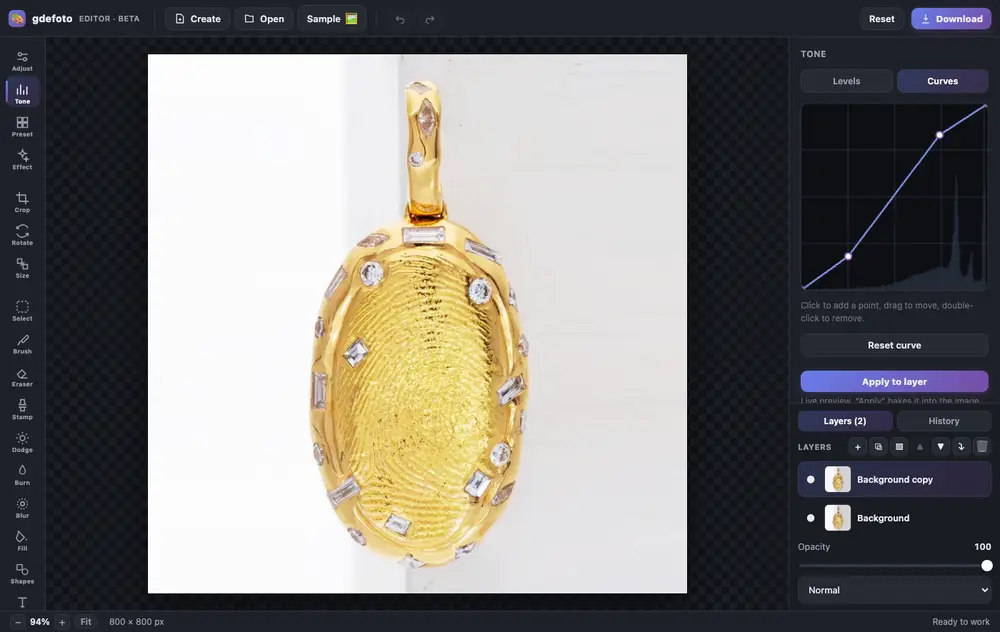
Crop, fix the light with curves, clean up with the clone stamp and add a caption. All in one tab, no install and no sign-up.
- Layers and masksBlend modes, opacity, masks painted with a brush or made from a selection.
- Light and colourLevels, curves, exposure, contrast, saturation and warmth.
- RetouchingClone stamp, dodge and burn, blur, brush and eraser. Crop, rotate and resize.
- AI built inColorize, restore, remove the background, upscale and sharpen: the result is added as a new layer.
- Text and shapesCaptions in the font you choose, rectangles and circles over the photo.
- In your browserNothing to install, no account. Full history with undo.
- Product photos: crop, brighten the background with levels, remove dust with the clone stamp.
- Old photos: restore with AI, colorize and add a caption.
- Social posts: a canvas from a size template, your shot and text on top.
Editing is free. Download is watermarked; remove the mark for $2.99.
Cutout and white background jewelry photos
Once a piece is cleaned and finished, it has to be moved onto a single white background. Cutting out jewelry is an art of its own, because the boundary of the object here is neither solid nor simple.
Unlike clothing or a box, a piece of jewelry has the most complex contour: the finest chains, openwork elements, loops, the posts and piercings for earring fittings, the gaps between links, the transparent areas of stones. A crude cutout along a simple contour immediately shears off the thin details, the chain disappears, the openwork turns into a solid patch. We perform the cutout while preserving the tiniest facets, chains, and posts, carefully separating the piece from the background so that not a single thin detail is lost and no dirty halo is left along the edge.
The background is made pure white, to the standards of product cards and marketplaces, while the piece keeps a natural soft shadow that anchors it to the plane and stops it from floating in a void. A pure white background (down to the requirement for pure RGB white on a number of platforms) is a baseline demand of nearly all major marketplaces, and white background jewelry photos are the standard to which we bring the entire catalog.
Do not want to fiddle with it? Hand the photo to a retoucher
Automation does not fix everything: a difficult frame, a photo that matters, an old print off a scanner. Where the algorithm gives up, a person works the picture layer by layer in Photoshop, by hand.

 BeforeAfter⇆
- Bring back sharpness in the face and eyes
- Remove noise and artefacts without plasticising the skin
- Fix colour, contrast and a broken exposure
- Remove scratches, stains and creases from an old scan
- Return a file large enough to print
- Price per photo$10
- Turnaroundwithin 24 hours
- Deliveryto your email
- If we cannot do itmoney back
We will finish your photo by hand
A studio retoucher fixes what automation cannot: sharpness, face, colour, defects. Pay first, then simply send the photo and tell us what you need. If we cannot do it, you get your money back.
- Manual photo retouching$10
Catalog unification: one style for the whole assortment
A separate task that is invisible on a single piece but critical at catalog scale is unification. When a buyer scrolls a catalog on a site or a feed of cards on a marketplace, inconsistency erodes trust in the brand more than any single flaw.
Catalog unification for Zevira involved several layers of work. A single angle and scale: similar pieces are shown from one angle and occupy a comparable share of the frame, so rings do not jump in size from card to card. Single shadows: one character and direction of the cast shadow across the whole catalog. A single color treatment against a reference: silver one tone everywhere, gold plating one warmth, so the same alloy does not look cold on one card and yellow on another.
On top of this come the platform requirements. The brand's own store has its own preferences for presentation and atmosphere; each marketplace has its own technical requirements for background, for the object's share of the frame, for file format and size. We prepare the catalog so the same set of pieces looks correct both in the brand's signature style on its site and passes the technical standards of external platforms. This is the full meaning of preparing product card images for marketplaces like Amazon, Etsy, and eBay: not just a pretty picture, but a file the platform will accept and that will work to drive a sale.
Flow and scale: a retouching pipeline for the catalog
Anyone can make one striking shot. The difficulty of a jewelry catalog is that dozens and hundreds of such shots are needed, and all of them must be held to one quality and one style. So jewelry product photography editing for an online store is not a one-off job but a built pipeline.
We structure catalog processing as a process: routine operations are moved into repeatable steps and presets, while unique manual work is concentrated where it is genuinely needed, on the stacks, the highlights, the stones, and the complex cutouts. This lets us hold speed across a flow of dozens and hundreds of SKUs without losing quality, because every piece passes through the same sequence of controlled stages rather than being retouched from scratch and at random each time.
This approach gives the brand the one thing it needs most: predictability. A new batch of pieces runs through the same pipeline and joins the catalog in the same style as the previous ones. The catalog can be regularly expanded and refreshed without losing visual integrity, which is exactly what a growing jewelry brand needs as it expands onto new platforms. You can see the breadth of the work in the brand's own catalog, where the diversity of collections by form, material, and symbolism is on full display.
The brief
Prepare a catalog of product card images for launch and ongoing updates on the brand's own store and on international marketplaces. The requirements were as follows:
- A clean white background to marketplace standards
- Natural metal shine without blowouts or parasitic highlights
- Readable engravings and symbolism on every piece at different preview sizes
- Accurate color rendering of silver, rhodium finish, and gold plating
- Conveying the play of stones without burning out into a white blob
- A single visual style for the whole catalog: one composition grid, one set of proportions, one light setup, unified shadows
What we did
The stages of work on the Zevira catalog images:
- Focus stacking: assembling a sharp piece from a series of 15 to 20 and more frames with different focus planes, manual merging of stacks, fighting micro-shifts and doubled facets
- Cleanup: removing dust, lint, scratches, fingerprints, and paste traces from the polished metal facet by facet at maximum zoom
- Metal retouching: dodge and burn for volume, rebuilding clean highlights and gradients on the polish, separating matte and mirror surfaces, reflection control
- Stone retouching: conveying the play and sparkle of brilliants and cubic zirconia, the color and saturation of natural stones without overexposure, preserving transparency
- Frequency separation and layers: working in hundreds of layers on masks and curves, separate treatment of chains, clasps, and small links
- Cutout onto a white background while preserving fine facets, chains, loops, earring posts, and the natural shadow
- Color correction for accurate rendering of 925 silver, rhodium finish, and gold plating against a reference
- Catalog unification: a single angle, scale, shadows, and color temperature across the whole catalog, preparation for the requirements of the brand's own store and the marketplaces
The result
The catalog of product card images is ready for launch and regular updates on the brand's own store and on international marketplaces. Every card reads equally sharp at different preview sizes, the symbolism and engravings on the pieces are recognizable, the metal looks natural and expensive, the stones play without overexposure, and the whole catalog is held in a single style.
The main value for the brand is that a repeatable process has been built. New batches of pieces run through the same retouching pipeline and join the catalog without inconsistency, which lets Zevira grow calmly, expand the assortment, and step onto new platforms without losing the visual integrity of the storefront.
Frequently asked questions about jewelry retouching
How many frames do you shoot for one piece?
For focus stacking a single piece, you usually shoot a series of 15 to 20 frames with different focus planes. For flat and compact items a smaller number can be enough, while for three-dimensional pieces with a chain, tiers, or complex relief the series grows to several dozen frames. The exact number depends on the depth of the piece and the chosen aperture: the thinner the slice of sharpness per frame, the more steps are needed to cover the entire volume from the nearest facet to the farthest without gaps in sharpness.
Why is focus stacking needed at all, can you not just stop down?
Not without losing quality. At macro distance, even at a medium aperture only fractions of a millimeter fall into focus, and if you stop down to f/16 or f/22 to increase depth of field, diffraction sets in and the whole shot goes soft: facets stop ringing crisp, stones lose their spark. You end up choosing between a thin slice of sharpness and overall softness. Focus stacking removes this compromise: each frame is shot at the aperture that is optimal for sharpness, and the required depth is built up by merging the series.
How long does it take to retouch one SKU?
The time depends heavily on the complexity of the piece. A simple smooth item moves faster on the flow, while a complex piece with a chain, enamel, multiple stones, and oxidation can require many times more manual work, because the retouching file is frequently hundreds of layers. At catalog scale we build a pipeline where routine operations are sped up by repeatable steps and manual time is concentrated where it is genuinely needed, so the average time per SKU on the flow is noticeably lower than retouching a single complex piece from scratch.
Is a white background mandatory, or can it be colored?
That depends on the platform. For product cards on marketplaces a clean white background is needed in most cases, on a number of platforms down to the requirement for pure RGB white. For the brand's own store a more atmospheric presentation is possible: a soft colored or textured background that supports the style of the collection. We prepare the catalog so the same set of pieces exists in both variants: strict white cards for marketplaces and signature presentation for the brand site.
In what formats do you deliver files for marketplaces?
We prepare files for the technical requirements of specific platforms: the required aspect ratio, resolution, the object's share of the frame, the file format and maximum size. For the brand's own store we additionally deliver lightweight web versions so the cards load fast without losing quality. If the platforms the brand works on have particular requirements for the backing, the margins, or the file weight, we build them into catalog preparation in advance, so the pieces are accepted without being sent back for revision.
What about edits if the result needs to be adjusted?
Because the retouching is done in layers, on masks and curves, pinpoint edits go in without redoing the whole job: you can change the character of a highlight, raise or calm the play of a stone, adjust the metal tone, strengthen or soften the shadow. At catalog level the edits are systematic too: if the color or presentation reference changes, we run the correction across the whole array, so the catalog stays unified rather than falling apart into mismatched cards.
Want the same result for your catalog?
If you are building a jewelry brand or an online jewelry store, tell us about your catalog: what pieces you shoot, what volume, which platforms you sell on, whether there are stones and complex symbolism. We will scope the work, propose a solution for the shoot and the retouching, and help bring the whole catalog to a single style under the requirements of your platforms. You can reach us via WhatsApp or email, with contacts in the site header.
We will edit a sample from your catalog for free
For online stores, manufacturers, brands and wholesale suppliers. Send 1-3 product photos and we will return them professionally edited, with a price quote for your whole catalog.
This is a b2b, volume format. We do not process personal photos (portraits, events, documents) here.
Request received
We will edit your sample and send the result with a catalog quote within one business day.